
95% of My Work Happens in VS Code
I barely use Word, Excel, PowerPoint, SPSS, or R Studio anymore. VS Code with AI assistants now handles my writing, analysis, slides, and tool-building in one place, and I work much faster for it.
Right now, as I write this, my desktop has six VS Code windows open. One for this article. One for a course I’m developing. One for a data analysis pipeline. One for a research paper draft. One for a custom tool I’m building. One for meeting prep. Behind them, a browser with a dozen tabs and my email.
I barely use Word, Excel, PowerPoint, SPSS, R Studio, Endnote, or even Overleaf in the browser anymore to do my work. And I don’t miss them.
Why VS Code?
VS Code is a free, open-source code editor made by Microsoft. It handles text, data, notebooks, and terminals as well as code. I use it in place of all those apps for four reasons:
- It’s free. No subscription and no “educational pricing.” Just download it and start working.
- AI assistants live inside it. GitHub Copilot, Claude, and other assistants see your files and your project context, and help you in real time. CLI tools like Claude Code, OpenAI Codex, and Google Gemini CLI run in the terminal inside VS Code, where they can edit files across your whole project and run commands and tests.
- Everything is a text file. Markdown for writing, LaTeX for papers, Python or R notebooks for data, HTML for presentations, CSV for data. You can search all of it, and git can track every change.
- One environment, zero context-switching. No more bouncing between Word, Excel, PowerPoint, and a stats package.
And if you’re an academic or student, sign up for GitHub Education and you get GitHub Copilot for free, plus a stack of other developer tools, with no reason to pay for Cursor, Windsurf, or any other premium tool. That said, once you start using AI assistants for everything, a paid tier gets you the best models and higher usage limits. I use the free tiers for OpenAI and Gemini, but I pay for Claude, primarily through their CLI tool, Claude Code.
What I Use It For
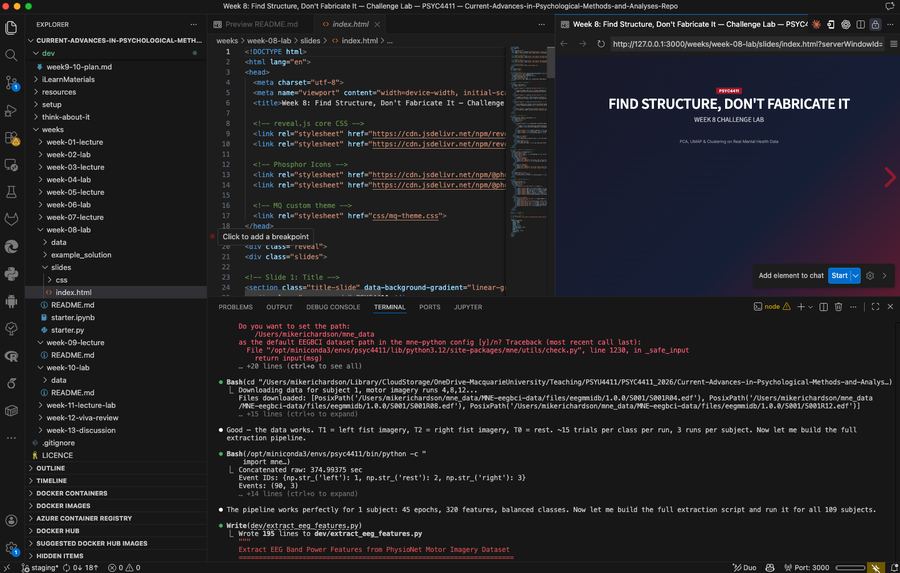
Writing
I write papers, course materials, blog posts, grant applications, and reviews all in Markdown inside VS Code. Markdown is plain text with simple formatting: **bold**, *italic*, # Heading. It takes five minutes to learn and works everywhere. For papers that need LaTeX, I use the Overleaf extension and edit those projects directly inside VS Code, with the AI helping me write and debug LaTeX without ever opening a browser tab.
Why not Word? Because Word files are opaque blobs that break version control, and their formatting gets messy when you collaborate. Worse, they lock your content into a proprietary format. Markdown is clean and portable, and git can diff and merge it line by line. When I need a formatted PDF or Word document for submission, I convert with a single command using Pandoc.
Data Analysis
I run Jupyter notebooks and Python scripts inside VS Code, using pandas, matplotlib, seaborn, and scikit-learn. The same notebooks and scripts produce the publication-ready figures for my papers. I can hand the AI a messy repeated-measures dataset and ask for a full mixed-effects model with post-hoc comparisons and a residuals check. It writes the code, I review and run it. It’s particularly good at catching statistical mistakes I might have glossed over. I haven’t opened SPSS or Stata in years.
Lecture Slides and Course Content
I’ve written in detail about how I code all my lecture slides in HTML using reveal.js and AI assistants. Reading guides, assignment briefs, rubrics, and student resources are also written in Markdown or HTML inside VS Code and kept in git, and I use the AI to draft and update them. If your university uses a platform like iLearn, Canvas, or Blackboard, you can paste the HTML directly in, and the pages keep the layout you designed in VS Code. You no longer have to build them in the platform’s own text editor, which is horrible to use.
Editing and Reviewing
When I review a paper or edit a colleague’s draft, I dictate my comments into a Markdown file as I read, then ask the AI to help me draft the review and make sure I haven’t missed anything. For grant reviews, I paste the criteria in too, so the AI helps me address every one systematically.
For privacy reasons, I don’t feed the paper or grant itself to the AI, only my own comments and notes. If I do need the AI to read a paper directly, I use a local model on my own machine, so nothing leaves my computer (more on why local LLMs matter).
Building Custom Tools
Because VS Code is a coding environment, I also build the tools I need. One is a benchmarking tool that scrapes publication and grant funding data, analyses it, and generates figures and slides, ranking my school against every other psychology school in Australia to identify our strengths and where we need to improve.
I’ve been coding for nearly 40 years, but what used to take me weeks or even months to develop I can now do in hours or days. With the AI, building a rough tool is fast enough that I now do it even for one-off tasks.
Research ideas, conference abstracts, reference management, and to-do lists go in VS Code too.
The Desktop
Every time you switch apps, you lose context. You wait for the app to load and then find your place in the file, and those switches add up to hours every week. When everything is in one environment, you don’t lose your place, and the AI assistant has your whole project in context.
”But I’m Not a Programmer”
You don’t need to be. Most of my research students in psychology have never written a line of code before they start working with me, and within a week or two they’re up and running. I even get my undergraduates going in a single one-hour lab, and by the end of the semester they use AI assistants fluently in their coursework. And, importantly, they know how to use these tools to enhance their critical thinking and problem-solving skills, not bypass them. (I write more about this in a related article.)
The AI writes the code, so you don’t have to memorise syntax or commands. You describe what you want, then check and run what it writes. Over time you learn to read and adjust code yourself. You don’t need a developer’s training in designing and maintaining software.
If you can write an email, you can use VS Code. Budget an hour or two to get comfortable, and after that you’ll work faster than you did across separate apps.
Getting Started
- Download VS Code. It’s free. Install it.
- Sign up for GitHub and GitHub Education. Use your university email. You’ll get Copilot for free.
- Install GitHub Copilot from the VS Code extensions marketplace. This is your AI assistant.
- Pick one task you currently do in another app (writing a document, analysing some data, creating a presentation) and try doing it in VS Code instead.
- Ask the AI for help constantly. “How do I create a Markdown file?” “How do I run a Jupyter notebook?” “How do I make this text bold?” There are no stupid questions when you’re talking to an AI.
And once you’re in, explore the extensions marketplace for Overleaf and LaTeX, Jupyter notebooks, CSV viewers, PDF readers, and Zotero integration.
For a step-by-step version of all this (setup, the extensions to install, and what to use it for) see the VS Code for Academics guide.
I think we’ll use fewer standalone SaaS applications and more environments like this one, where you build a small tool when you need one. You won’t switch everything overnight. I didn’t. But once you see how much faster you work with an AI assistant in a unified environment, you’ll start migrating more of your workflow, and the separate apps will quietly disappear from your dock.
Michael Richardson Professor, School of Psychological Sciences Faculty of Medicine, Health and Human Sciences Macquarie University
AI Disclosure: I wrote this article with help from AI tools, including Claude. The ideas and the workflow described here are my own. The AI helped me draft and edit the text. I use AI throughout my research and teaching, and I encourage others to do the same. Using AI well is a skill to be learned openly.
The AI models used here, like all current LLMs, were trained on vast quantities of text written by others, largely without explicit consent. Every output they produce draws on the ideas and language of countless researchers and writers. Their labour makes these tools possible, and I want to acknowledge it even where no individual can be credited.