
Your Writing Is Drifting and You Won't Notice
The ideas are still yours. So is the theorising, and most of the sentences. The writing drifts anyway. Marginalia learns how you actually write from your own published work, then flags where a draft stopped sounding like you.
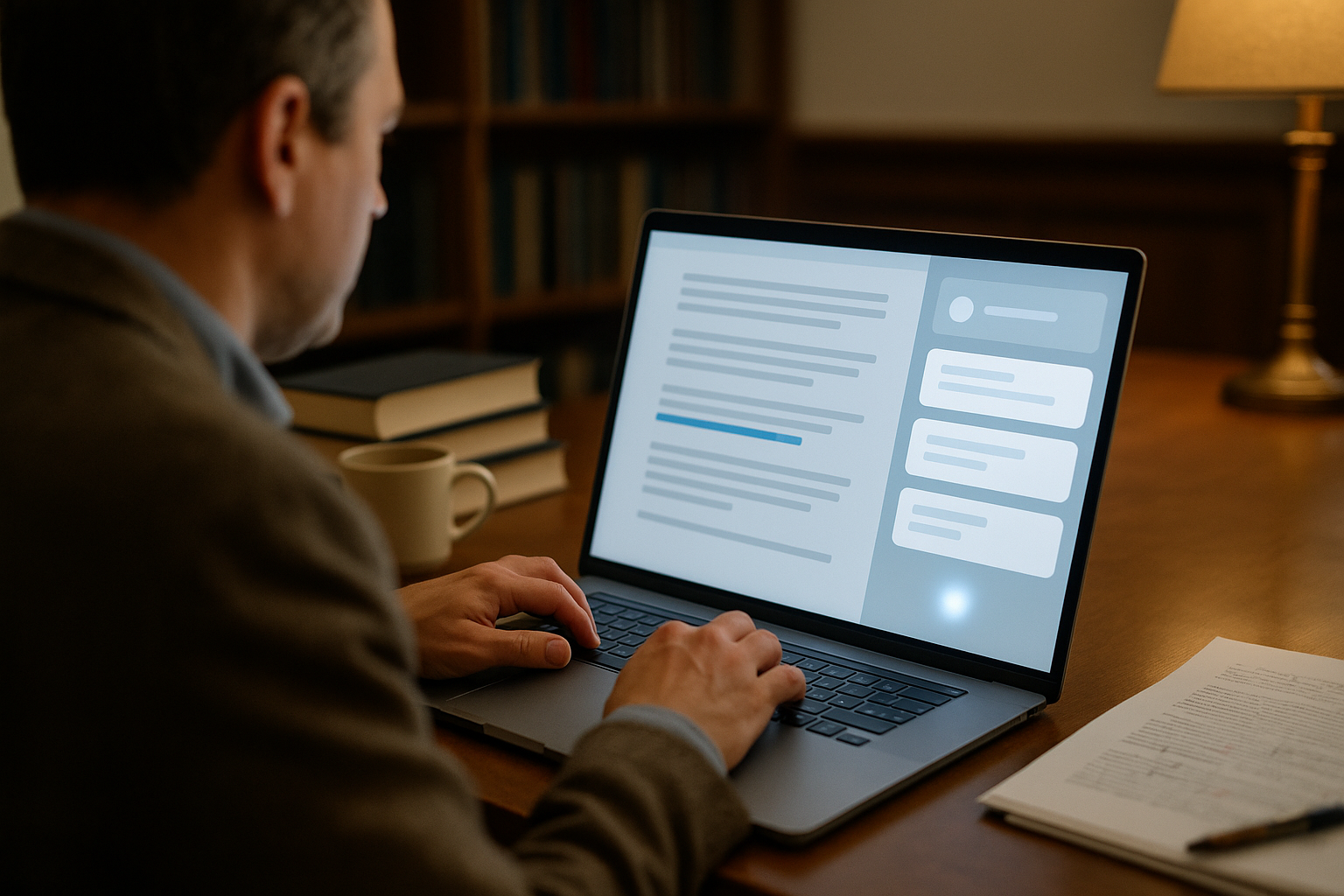
If you work anything like I do, AI is already somewhere in your writing pipeline. Not writing your papers for you. Checking the grammar. Getting you past a blank morning. Smoothing a transition you’d already rewritten four times. Confirming your reference list still reflects the literature, then adjusting the text to match.
The thinking stays yours through all of that. The ideas, the theorising, the creative leaps, the shape of the argument. Most of the sentences are still typed by your own hand.
The writing drifts anyway.
Read a section back a week later and something has gone missing. The sentences are shorter than the ones you write. Your hedges have moved to the front of the clause, where you’d normally bury them. Words you have never once typed (delve, underscore, seamless) have quietly settled in. The prose is smoother than anything you write, and it is no longer recognisably yours.
That’s drift, and it’s hard to catch because it arrives one acceptable edit at a time. No single suggestion is wrong, and you accept fifty across a chapter before noticing the voice has gone.
Citations go the same way, with worse consequences. AI-assisted drafts carry references that don’t exist, references with the wrong year, and real references that don’t support the claim attached. That last kind gets through review.
But you already have what it takes to catch this, and you wrote it yourself. Every paper, chapter and grant you finished before these tools existed is a record of how you actually write, and unlike a draft it doesn’t drift.
Tools are appearing that use it. I built one for academics, called Marginalia.
What it does
Marginalia learns your voice from that corpus, reads a draft, and tells you where it stopped behaving like you. It also checks that every citation exists, is accurate, and says what you claim.
Most writing tools hold you to generic rules about good writing. Shorten that sentence. Cut the passive. Marginalia holds you to your own corpus. If your sentences run long and clause-dense, it won’t tell you to trim them, only that a draft stopped running that way.
It’s a critic, not a ghostwriter. It reports what it found and you decide, and it never edits a file without showing you the change.
Getting it
I use it with Claude Code, so it ships set up as a skill for that. It isn’t tied to Claude though. Almost everything it knows is plain English rather than code, so it ports to Codex, Gemini CLI or whatever you use. Clone the repo, open your assistant in the folder, and ask it to set itself up. The repo explains its own structure, so it installs the skills and builds your profile from your own writing, PDFs and Word files included.
github.com/xkiwilabs/marginalia
Point it at your own back catalogue before you point it at a draft. A couple of pieces is enough to start, and it sharpens as you add more.
Michael Richardson Professor, School of Psychological Sciences Faculty of Medicine, Health and Human Sciences Macquarie University
AI Disclosure: This article was written with the assistance of AI tools, including Claude. The ideas, opinions, and experiences described are entirely my own. The AI helped with drafting, editing, and structuring the text. I use AI tools extensively and openly in my research, teaching, and writing, and I encourage others to do the same.